Adolescence – School Episode – Take it Personally

I watched episode two of the Netflix series Adolescence last night. 

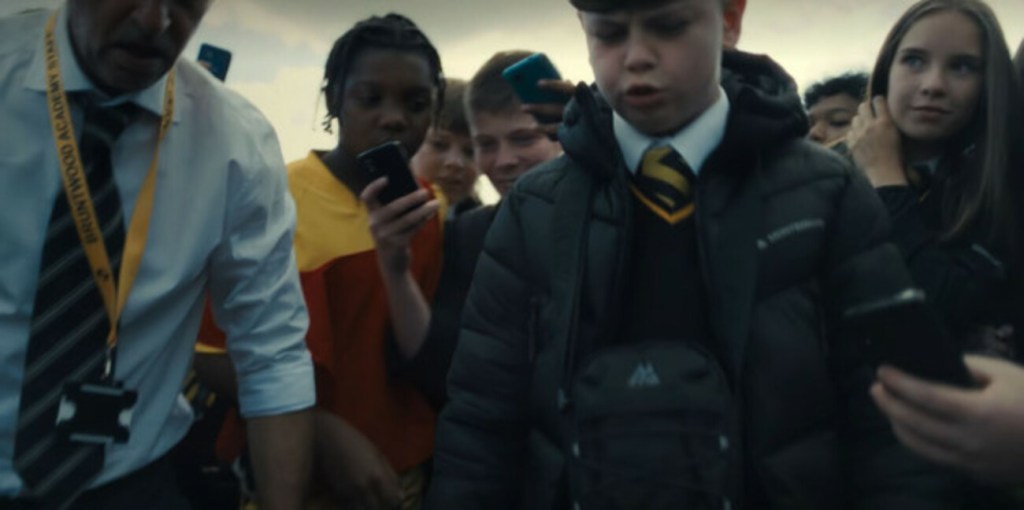
It’s the episode that takes place at school, and it’s easy to see what’s wrong with the school depicted. It’s something I’ve often seen in real life.

The problem is that the school staff is not taking it personally. 

Many illustrative examples of this follow throughout the episode as they roam the hallways and classes, but the first time it got my attention was early. One student steps into another student’s personal space, aggressively backing him against a wall, and demanding money. A teacher walks by and tells him to stop. The bully stops. The teacher continues on to their destination. 

The teacher has achieved something close to nothing with this interaction, because the teacher didn’t take it personally.
It’s not nearly enough for teachers and school staff to simply tell students to follow rules in a technocratic and impersonal manner. While it is necessary to maintain basic rules, that is a very low bar for what we can expect from school staff. It cannot, on its own, engender a healthy and safe school culture.

Now, there is a certain way in which I encourage school staff to take it personally, and it is not in the I/ego sense. When it comes to their own personal ego and vulnerabilities, school staff often need help with not taking it personally. Not taking things personally, in this ego-based sense, is one of the greatest gifts one develops when becoming a mental health professional, and I strongly encourage teachers to develop this.

What we must take seriously and personally is the authority vested in us as school staff. In an effort to remain safe and secure, the students have a narrow range of options and no authority. School staff, on the other hand, have many options and are part of a whole network of adult authority.

The students are counting on us to keep their school environment safe. What you should take personally is any assumption that you might abdicate such a responsibility. -That you would look away, whether they are acting out, or in danger.

The bully demanding money is taking their aggression out on their target, which is very personal to both the bully and their target. (And to be clear, the interaction is not about money, it’s about dominance.) That personal aggression is intense and will not simply evaporate. The school staffer’s job is to get the bully to transfer their sense of conflict to the school staffer, who is standing in for the expectations of the entire school institution. You transform the conflict from existing between the bully and the target (who has no or limited options in protecting themselves), to the conflict existing between the bully and the institution of school (which has many options and a network of supporting adults).

When you are a school staffer, the authority vested in you means you are “on watch”, and the vibe about behavior that threatens a safe learning environment should be “not on my watch.”

I also encourage teachers and school staff to pay attention to not just the obvious incidents, but also to the sense of threat in the environment. This is something teachers should largely trust their personal sense about, maintaining classes that are safe-enough and also feel safe-enough. Sometimes, I see the bar set so low that nothing is considered an offense or worthy of concern unless a student is getting injured. This is a desperately low bar, and we must aim much higher than that. We can’t have a real learning environment otherwise.

More teachers and school staffers should add incredulity to their mix of available responses to school behavior. Violence is both terrible and absurd. It is an absolutely horrible way, and an absolutely ridiculous way, to address a need or challenge. I find it helpful to respond with incredulity to students who are threatening violence. In doing so, I am projecting onto them the basic requirements of civilization. Your response to threatening language may be as simple as “No, you’re not.” The vibe, which usually goes unsaid, is: The idea that you would act out violently on my watch, in the school where I work, is absurd. I take it personally that you would imagine I would stand for such a thing. 

In addition to shutting down the idea of violence, we must have empathy for our students and be prepared to work with them in developing and accessing non-violent ways to address their needs and challenges.

Informing Students About Observations: My Unpopular Opinion

Here’s my unpopular opinion: Students of any age in schools should be notified about formal observations. 

Student observations are a common and important evaluation method in special education. Observations are part of nearly every initial special education evaluation process, as well as many other processes including general progress measurement, re-evals, and as part of placement considerations.

My opinion rests on a few fundamental beliefs:

It is respectful and ethical to inform any person that they are being observed. It is a gesture of respect that most people would appreciate, regardless of whether they are minors.

It is best to maintain a classroom where any and every visitor is identified. A classroom, even a large classroom, is a defined and close group that spends an enormous amount of time together. All non-members who enter the space are noticed by most of the students. -And some students wonder, speculate, and worry about the purpose and intentions of visitors. All the members of the classroom group deserve an introduction of visitors and a brief explanation of their purpose. In my classroom, the student being observed will be aware of the specific purpose of the visitor. Depending on circumstances and the privacy preferences of that student and their parents, it may be appropriate to tell the class that the visitor is here to “see the classroom”. -A truth that respects privacy concerns.

The third fundamental belief I will share is a bit more complex to explain. I often hear the concern that knowledge of the observation might impact the student’s performance during the observation. This is true. We can’t easily measure or correct for the impact of knowledge of the observation on the student’s performance. But we also can’t easily measure or correct for the impact of having an unusual and unexplained person in the room observing. Given these two possibilities, I’d much rather choose the option in which people receive respectful communication.

In research involving minors, the relevant concepts are informed consent and informed assent. In research, it is best practice to obtain informed assent from minors along with informed consent from their guardians. In some cases researchers record the minor’s informed dissent along with their guardian’s informed consent. School observations should be treated with the same respect. A student’s dissent to being observed is valuable information to record in one’s observation, should it go forward.

I recommend informing the student about any upcoming observation some days in advance, and reminding them about it each day leading up to the observation. If the observer is unfamiliar to the student and there is an opportunity to have an introduction before the day of observation, I would recommend that as well. If that is not possible, sharing a picture of the observer will help decrease the uncertainty. I recommend that you simply treat the student with at least the same respect that we understand most people would appreciate being treated with under similar circumstances.

What Kind of Teacher Doesn’t Know the Answers?

spoiler: sometimes not knowing the answers is what makes an educator great

The Constrained Psychology of Educators Part I

I’ve had time to observe many of the psychological pitfalls of being an educator in K-12 schools. The effect is one of constraint, where educators experience a limited scope of what is possible in the classroom. 

My work has been primarily with students in special education programs due to significant social, emotional, and behavioral challenges, and their educators. The intensity of the issues presented by these students bring school culture concerns into clearer focus, but many of these issues are pervasive throughout schools.

The layers of these constraining problems are built on a foundational idea about school: teachers have all the answers. What a reassuring idea! In some parts of school life, it’s true. Your second-grade math teacher has in fact memorized the multiplication tables, and more. 

It can be largely true in more complicated situations as well. Your special education teacher may be able to administer assessments and know quite confidently what reading intervention is likely to be effective. Special education teachers are often amazing.

And then we encounter a student who is really struggling emotionally. This emotional distress is showing up in their behavior and interfering with their access to education, and to some degree even interfering with other students’ access to education. The usual incentives and disincentives for “good student behavior” are ineffective. We have reached a point where we educators no longer know the answers. 

This is a frightening crossroads for many, cutting to the heart of the teacher identity. What kind of teacher doesn’t know the answers?

Blocking out this troubling question, educators seek quick answers, hoping to return to their regular knowledgeable position as quickly as possible. Someone administer an FBA! (Functional Behavioral Assessment) 

Educators are increasingly taught that the answers lie in data. Let me be clear, data is a fundamentally good thing – more information is better than less. But, educators fall prey to the comforting illusion of easy and understandable answers. They feel the pressure of the expectation to be an expert, and an expert teacher (or school counselor) must know the answers. Welcome to perfect storm conditions for imposter phenomenon. 

Children, their families, and classroom groups are complicated. An individual child can’t entirely account for their behavior, thoughts, and feelings. -Nor can we do it on their behalf. We can’t even entirely account for our own behavior! Have you ever done something you intended not to do, or not done something you intended to? Why do you keep doing that?

However, we can move toward deeper understanding together. Part of what Laura Balogh and I advocate for in our book The Therapeutic Inclusion Program is shifting the classroom culture toward curiosity, wonder, and collaboration. We can think about it together. The more we do that, the more we will understand, but we still won’t know all the answers.