Blog

First steps as co-president of the Northeastern Society for Group Psychotherapy

As of today, Annie Burke and I are co-presidents of the Northeastern Society for Group Psychotherapy (NSGP).

NSGP is a volunteer, professional organization. So first off – I hope to enjoy this, so that others will also want to lead.

Here are some initiatives I’d like to lead with over the next two years as co-president:

-The 2026 conference is coming into focus, front and center. It will be held October 16th through 18th, at Lesley University in Cambridge. Our conference is our flagship event, where our community really comes together and shines.

-Growing into a Northeastern Society for Group Psychotherapy. We’ve made progress on this front, but there is so much opportunity for more. Our by-laws say NSGP encompasses “Connecticut, Maine, Massachusetts, New Hampshire, Rhode Island, and Vermont.” We welcome members across the Northeast to join us, and use hybrid meetings to make leadership positions in the organization open to everyone.

-Keeping the group psychotherapy conversation going. The life and health of group psychotherapy is supported by our conversations. Culture changes, politics changes, the marketplace changes, and the only way that group psychotherapy thrives, develops, and adapts is through coming together to try and make sense of it. All of us who work with groups need these conversations to do our best work.

-I’d like to better understand what is happening economically for group leaders. Under what conditions do groups work economically in private practice, and within institutions? How has the marketplace changed and how is it changing?

-Continuing to welcome new members to NSGP, reflecting the diversity of the Northeast in every respect. The majority of groups are offered in schools, hospitals, and recovery programs, and we want these group leaders to be a bigger part of our community, conversations, and events.
Mood Sampler App available for iPhone


I believe that there is nothing more significant and valuable in terms of evaluating your well-being than your subjective sense of how you are in any given moment.

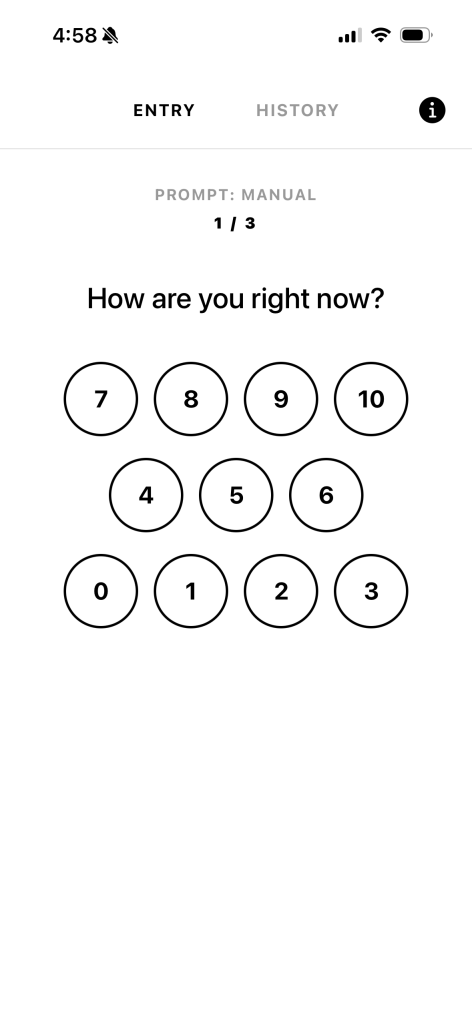
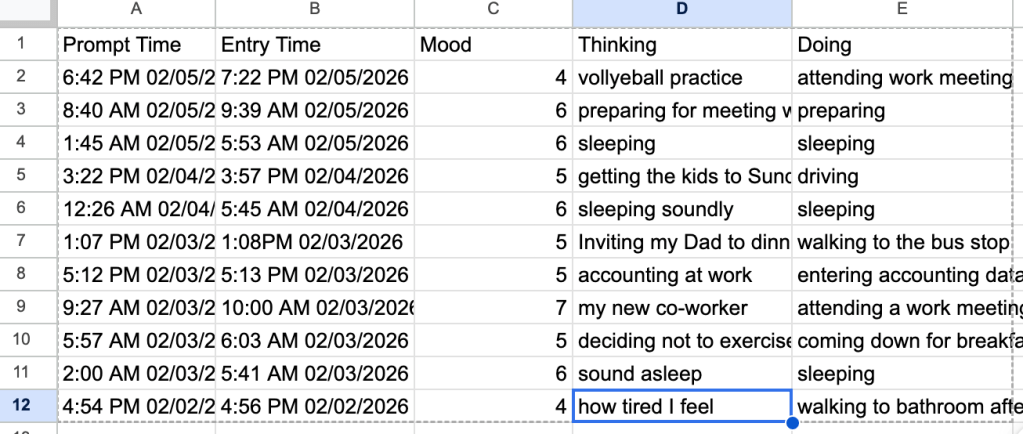
I found it interesting to sample these moments at random and keep a log. I came up with a useful 0-10 mood scale. And, after 30 days of twice-daily random prompts, I looked at the data on a spreadsheet and gained some insight into my mood and the bigger picture. I was interested in my average mood over time, and how different activities, thoughts, and times of day were linked to mood fluctuations.

And now, I’ve made an iphone app that makes it easy for anyone with an iphone to do this.

The app prompts you twice a day to rate your mood, and enter a little info about your thoughts and activity. It keeps all the data local on your phone, so there’s no information going anywhere else. And when you are ready, you just tap “export spreadsheet” and you get all your data organized in a .csv file that can be opened in excel, or google sheets, etc.


I wanted to call it Mood Sampler but Apple says someone is using that name. (-Not that I can find any evidence of that!) So, I named it Murray Mood Sampler. I might change the name to Random Mood Sampler, if I can. Regardless, check it out! -Learn about your moods.

Trump Admin DEI Executive Order from January 2025 Null and Void – Permanently

Some important news that is not rising to the top of the headlines:

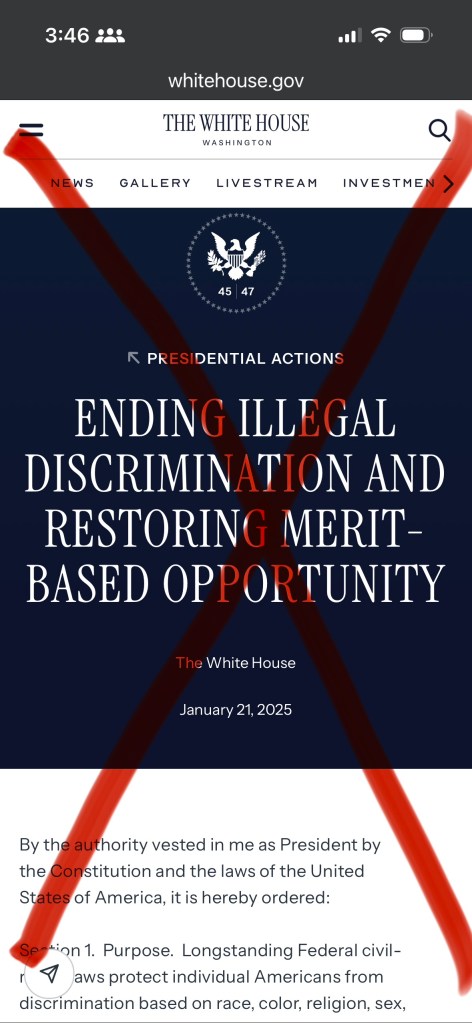
The Trump Administration’s January 21st 2025 executive order regarding DEI is null and void, and the administration has decided not to appeal the decision.

“The U.S. Department of Education, on Jan. 21, 2026, withdrew its appeal to the U.S. Court of Appeals for the Fourth Circuit aimed at defending its anti-DEI Dear Colleague Letter issued last year. The Trump Administration’s decision to formally drop its appeal leaves in place a federal district court’s ruling finding the Dear Colleague Letter unenforceable.”

I know this letter frightened a lot of people. I called it “hot garbage” in my blog post shortly after release. I encourage you to take some reassurance in knowing that when something is clearly total nonsense, there’s a reasonable chance it will be recognized as so in a court of law.

-Link to the article from Bond, Shoeneck, & King Attorneys site.

Finding our National ‘Absolutely Not’ in Greater Boston

from the personal realm to the national realm, the ideal time for “absolutely not” can easily be missed, but it also can be reestablished

Parenting and teaching are significant focuses of my work. Teachers and parents are authorities, and they are wise to exercise their authority thoughtfully. There are many opportunities to leave room for error, to allow children to find their own paths, and to discuss, compromise and see what develops. 

There is also a time for “absolutely not.” 

A good example of a time for “absolutely not” is when children hit. We can work with some poor negotiation skills, we can leave space for children to work out differences, however clumsily. But when children hit, it’s time for the adult in charge to say “absolutely not”, or their own version of it, and stop the behavior right away. Sometimes a behavior like hitting can start quietly in small ways, and we may not recognize it right away. However, missing the time for “absolutely not” doesn’t mean we can’t establish it once we realize it. In fact, it’s extra important that we do.

This brings me to the national realm. In the United States, our idea is that the people are the ultimate authority.  Clearly, our nation lives up to that idea to various degrees over time. I think we missed the initial right time for “absolutely not”. The introduction of masked federal agents should have provoked an “absolutely not” response from the people. Instead, it has taken the videoed killings of two American citizens in our streets to get us to pay attention and say “no.” And now, it becomes crystal clear that we absolutely cannot have armed, anonymous, masked federal agents on our streets or knocking on our doors. 

If and when they are seen in Greater Boston, I hope those of us who can risk doing so stop what we are doing, stand up to them, tell them clearly and non-violently, with our words and our presence “absolutely not!” We must do everything we can while remaining non-violent to make it clear that they are not welcome here in their masks, dressed and armed for war on the streets of America. ICE out now.

Maintaining Your DEI Intgegrity – A One Day Program in Boston on Saturday October 25th

Since Trump’s re-election and the ensuing governmental assault on diversity, equity, and inclusion, I have taken a lot of heart from Carlos Hoyt’s writings.

Carlos was my Clinical Skills professor in my graduate program. I am looking forward to co-facilitating this workshop with him, and Suki Cintron. The workshop is open to anyone working in schools to maximize inclusivity during these very challenging times.

Learn more here: https://www.carloshoyt.com/

Or send me a message and I can share more information with you.